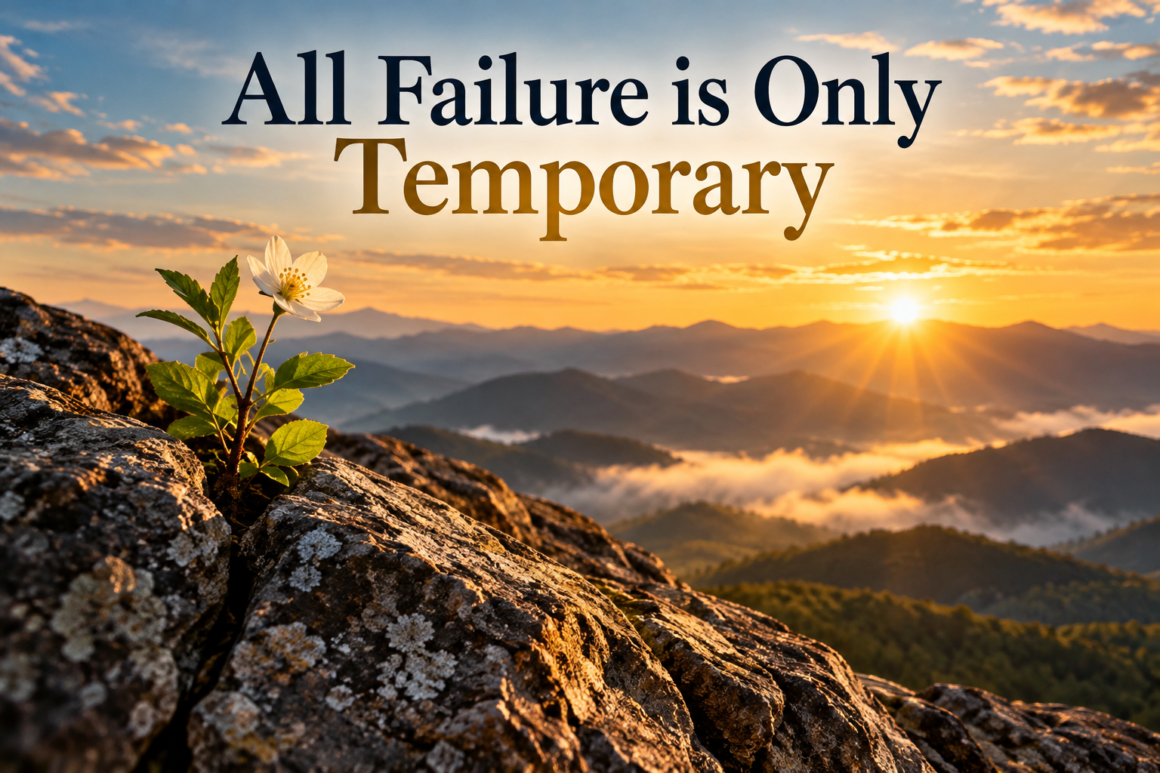
All Failure Is Only Temporary
The Extraordinary Power of Flexibility
By Kurt R. Turrell
All failure is only temporary. Flexibility is what makes it so. Let me prove it to you!
In the late 1870s, Thomas Edison and his research team were working toward something extraordinary: developing an electric light bulb that could illuminate homes and businesses safely, reliably, and economically.
The objective was clear enough. Achieving it was another matter entirely!
The team conducted hundreds of experiments, testing different materials, designs, and methods. Some showed promise, only to reveal unexpected problems. Others proved unsuitable almost immediately. Each new possibility required investigation, experimentation, and, quite often, another adjustment.
Eventually, their persistence and experimentation produced a practical incandescent lamp. In 1879, they demonstrated a bulb that could burn for more than thirteen hours, an important breakthrough that helped establish the foundation for modern electric lighting.
Now, consider something about this achievement.
What would have happened if Edison and his associates had concluded, after a few hundred unsuccessful experiments, that they had failed?
Fortunately, they didn’t!
Instead, they continued learning, reconsidering their assumptions, adjusting their methods, and exploring new possibilities.
Each unsuccessful experiment provided additional information. A particular material might not perform adequately, but discovering that limitation contributed to their understanding of what was needed.
And therein lies something I find absolutely fascinating.
The experiments could fail without the ultimate objective becoming a failure!
The scientists didn’t need every experiment to succeed. They needed to remain sufficiently open-minded to recognize what each experiment revealed and flexible enough to act upon that knowledge.
What an extraordinary lesson for the rest of us!
And yet, I believe we routinely overlook its importance.
The Difference Between Failure and Ultimate Failure
Many years ago, I began developing a personal philosophy that eventually became the sixth and final step in my 2009 book, 6 Steps to Lifetime Success & Abundance.
That final step was Flexibility.
I described it as the glue holding the other five steps together. Motivation, preparation, goal setting, research and development, and consistent action were all important elements of achievement. But something essential was missing without flexibility.
What happens when our plans don’t work? When we discover that our assumptions were incorrect? When an objective proves unrealistic, or circumstances change in ways we could never have anticipated?
We adjust!
What else would an intelligent, open-minded person do?
This is where I began questioning the conventional understanding of failure.
A business venture may not succeed. An experiment may produce disappointing results. A carefully developed plan may prove impractical. These things certainly happen, and there is little reason to pretend otherwise.
But are they ultimate failures?
Not necessarily. In fact, I would argue that none of them needs to become an ultimate failure.
Because something remains available to us, regardless of the original outcome.
The freedom to reconsider, revise, adjust, and continue.
That’s flexibility!
And as long as we retain that freedom and exercise it, our possibilities remain open.
The important distinction is not whether a particular effort produced the result we anticipated. The distinction is how we react to that result.
We can accept disappointment as a permanent verdict, or we can recognize it as part of a continuing process.
Our reaction makes all the difference.
Consider What Sports Can Teach Us
I love sports, partly because athletic competition provides such wonderful illustrations of human determination, adaptability, and achievement.
Consider football.
A team needs a first down but fails to gain the necessary yardage. Possession changes. An opportunity has been lost.
Was that particular effort unsuccessful? Absolutely!
But the game isn’t necessarily over. The coaches can reconsider their strategy. The players can recognize what went wrong. When another opportunity presents itself, they can approach it differently.
Perhaps their adjustments will lead to victory. Perhaps not.
Sports are designed around rules that establish precisely what constitutes success or failure within a particular play, contest, or season. But those rules also create repeated opportunities to respond, adapt, and improve.
The scoreboard can tell us who won a game. It cannot tell us everything that was learned, accomplished, or made possible because that game was played.
And life is certainly not restricted to the rules of a sporting contest!
We establish our own ambitions, develop our own expectations, and pursue whatever opportunities we believe will enrich our lives.
Sometimes we discover that what we originally wanted is no longer what we want at all.
Does changing our minds constitute failure?
Of course not!
Indeed, it may be one of the wisest decisions we ever make.
Flexibility Is the Foundation of Open-Mindedness
Think about what it really means to have an open mind.
We generally associate open-mindedness with a willingness to consider different ideas, opinions, and possibilities.
But there is more to it than that.
An open mind must also possess the willingness to change.
Otherwise, what good is it?
We can listen to different perspectives all day long. We can read books, attend lectures, study scientific discoveries, and encounter countless new ideas. But unless we are willing to reconsider our existing beliefs in light of what we learn, our minds remain essentially unchanged.
Flexibility is what converts open-mindedness into meaningful action.
And this brings us back to scientific experimentation.
A scientist whose hypothesis proves incorrect has learned something important. The evidence may require adjustments to the original hypothesis or perhaps an entirely different approach.
Imagine refusing to reconsider a hypothesis simply because we had invested years defending it!
How much scientific progress would be possible if researchers insisted upon being right instead of being willing to discover what is true?
The same principle applies to our personal lives.
We should be willing to reconsider virtually anything when new knowledge or changing circumstances warrant doing so.
And that includes our most cherished beliefs.
I have long been interested in the teachings of people who explore human potential, including Dr. Joe Dispenza, whose work encourages individuals to recognize and change habitual patterns of thinking, feeling, and behaving.
I would place particular emphasis on flexibility as an essential companion to such teachings.
Positive thinking can be tremendously motivating. Believing in ourselves and envisioning a desirable future can encourage us to pursue possibilities we might otherwise overlook.
But what happens when the future we envision proves unrealistic? Or when we discover something even better?
Surely, we shouldn’t become prisoners of our own positive expectations!
We must remain flexible enough to change our beliefs, even when those beliefs are positive.
There is no contradiction between maintaining a positive attitude and recognizing that we may need to reconsider our conclusions.
In fact, I believe the combination is extraordinarily powerful.
We can be confident without being stubborn. Determined without becoming unreasonable. Optimistic without ignoring reality.
We can even disagree with one another without becoming adversaries.
After all, intelligent disagreement can be a wonderful opportunity for discovery when both parties are willing to reconsider their thinking. The objective need not be defeating another person’s argument. It can be improving our mutual understanding.
That is flexibility at work!
What About the Goals We Never Achieve?
There is another consideration that has become increasingly important to me as I have grown older.
Time.
We human beings are mortal. None of us knows precisely how much time remains available to pursue our ambitions, explore our interests, or experience the many possibilities life has to offer.
Suppose someone spends an entire lifetime pursuing a worthwhile goal but dies before achieving it.
Has that person ultimately failed?
I certainly don’t believe so!
Consider an inventor who spends decades developing an important technology. The inventor never completes the work, but the knowledge accumulated along the way eventually enables others to accomplish what had previously seemed impossible.
Was that lifetime of effort a failure?
Or consider someone who dedicates years to building an organization, helping others, or pursuing an extraordinary personal ambition. Circumstances change, opportunities come and go, and the original objective remains unfinished when that person’s life ends.
Does the absence of a particular achievement invalidate everything that occurred along the way?
Of course not!
Running out of time is not the same as giving up.
There is no guarantee that we will achieve every objective we establish. Nor is there any reason to believe that achievement must always resemble what we originally imagined.
Life continually introduces possibilities that we couldn’t possibly have anticipated.
And flexibility allows us to recognize and pursue them.
That is one reason I believe our reactions are so important.
We cannot always determine what happens next. But as long as we are capable of making choices, we can exercise flexibility in deciding what to do with what happens.
We might discover an entirely new direction!
There Is Only One Way to Ultimately Fail
By now, perhaps you can see why I have become so convinced of the extraordinary power of flexibility.
Temporary failures are part of human experience. We encounter them in virtually everything we undertake.
But temporary failure need not become ultimate failure.
As long as we remain flexible in our thinking, willing to learn, and determined to continue, every experience can contribute something to our ongoing development.
And this leads me to a conclusion that I consider both remarkably simple and profoundly important.
There is only one way to truly fail: Give up!
Think about that.
We can make mistakes without giving up. We can change our minds without giving up. We can abandon an unrealistic objective, revise our methods, or pursue an entirely different ambition without giving up.
Flexibility makes all of these adjustments possible.
Indeed, giving up on a particular approach may be exactly what we need to do to continue progressing toward something worthwhile.
That isn’t surrender. It’s intelligent adaptation!
The surrender I’m talking about is something altogether different.
It is the deliberate abandonment of our willingness to consider alternatives, learn from experience, and pursue whatever worthwhile possibilities remain available to us.
And that means ultimate failure is deliberate!
Not because we choose every circumstance that affects our lives. We certainly don’t.
But because, in the sense I am describing, ultimate failure is not imposed upon us by an unsuccessful outcome. It arises when we surrender our willingness to continue.
And even that need not be permanent!
Consider someone who has abandoned an ambition, convinced that further effort would be pointless.
Years later, new information becomes available. Circumstances have changed. Perhaps an unexpected opportunity appears.
The person reconsiders.
Suddenly, what once appeared to be an insurmountable obstacle becomes an opportunity to begin again.
Was the earlier surrender necessarily the end?
Apparently not!
Through flexibility, the person has reopened possibilities that once seemed permanently closed.
And therein lies something wonderful about the human capacity to change.
We can even reconsider our decision to give up!
The Ultimate Cure for Failure
Imagine approaching life without the constant apprehension that an unsuccessful effort might somehow define us.
Imagine being willing to explore unfamiliar possibilities, experiment with new ideas, and pursue ambitious objectives without fearing that an unexpected outcome would constitute a permanent personal defeat.
We wouldn’t need to know all the answers before beginning.
We wouldn’t have to be right all the time.
We could acknowledge our mistakes without allowing them to dictate our future. We could recognize changing circumstances without becoming discouraged by the adjustments they require.
And perhaps most importantly, we could approach each new experience with genuine curiosity rather than apprehension.
What might we discover? What could we learn? Where might an unexpected turn lead us?
Think of the freedom that such a philosophy offers!
Flexibility does not require us to abandon our determination. Quite the contrary. It allows us to remain determined without becoming imprisoned by expectations that may no longer serve us.
It encourages an attitude of continuing exploration, discovery, and growth.
And it provides a practical answer to one of the most discouraging beliefs we can develop about ourselves: that we have failed and therefore should stop trying.
There is no need to accept that conclusion.
We can reconsider it!
For me, this is not merely a motivational technique. It is a philosophy of living, one that recognizes the extraordinary possibilities available to those who remain receptive to change.
I cannot know everything that tomorrow will bring. I cannot guarantee that my present ambitions will be realized, or that my understanding of what I want today will remain unchanged in the years ahead.
Nor would I want to!
There is simply too much left to discover.
I intend to keep learning, questioning, exploring, and adjusting for as long as I possibly can.
And should something I attempt tomorrow produce disappointing results?
Well, I suppose I’ll just have to reconsider my approach!
After all, the ultimate cure for failure is flexibility.
We may stumble. We may encounter extraordinary challenges. We may even discover that the goals we once considered essential are no longer worth pursuing.
But as long as we remain open-minded, willing to adjust, and determined to continue, our opportunities for progress remain alive.
And that is why I believe, with considerable conviction, that all failure is only temporary.
Unless we give up!
© 2026 Kurt R. Turrell. All rights reserved.