Cancer Cures Are Coming: A New Dawn in the Fight Against Cancer
Artificial Intelligence May Change Everything!
I am absolutely overjoyed to report that something extraordinary may be happening in humanity’s long and often heartbreaking battle against cancer. Something that offers genuine reason for hope, not merely for future generations, but quite possibly for millions of people living today.
And that something is artificial intelligence.
For as long as most of us can remember, cancer has been among humanity’s most feared enemies. We have watched brilliant scientists devote their careers to understanding it, physicians struggle to defeat it, and countless families endure the terrible uncertainty that accompanies a diagnosis.
There have been remarkable victories, certainly. Some cancers that were once considered death sentences are now routinely treatable, and many are curable. Yet far too many others continue to take lives despite decades of determined research.
But what if the next great breakthrough doesn’t come from simply doing more of what we have always done?
What if it comes from an entirely new capacity to understand the biological mysteries that have frustrated researchers for generations?
That possibility is no longer confined to science fiction.
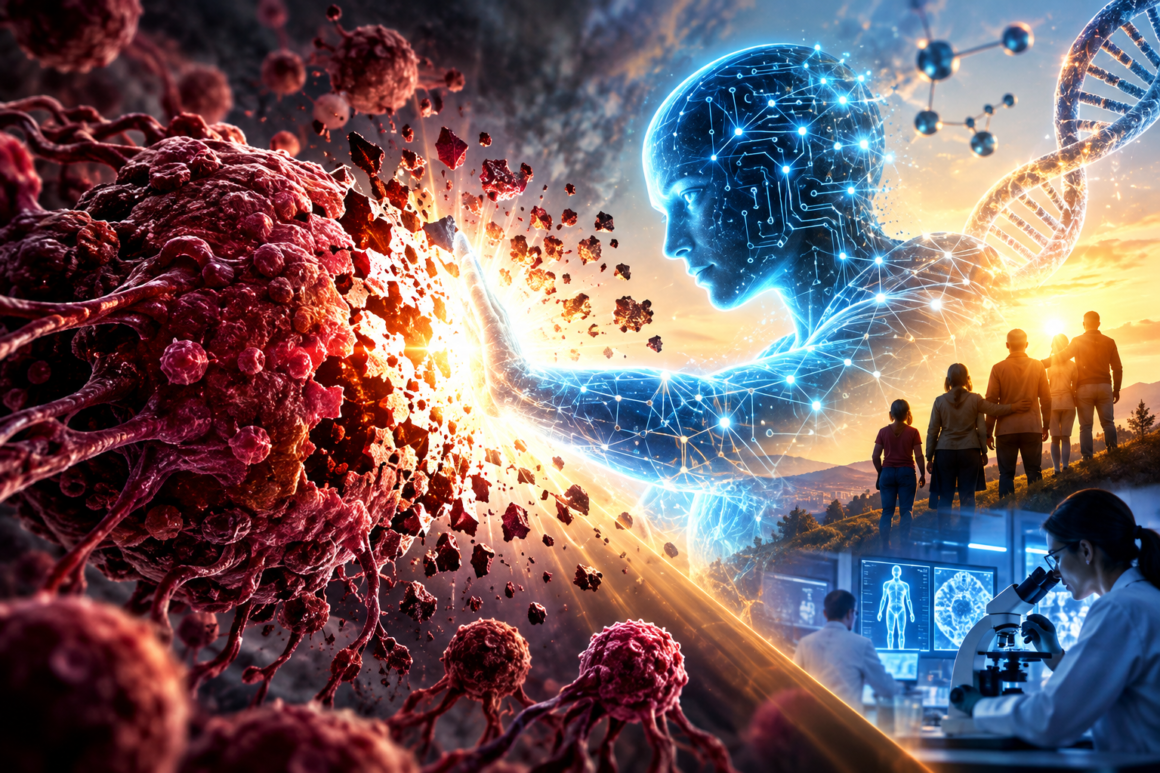
AI has entered the laboratory, and the implications are extraordinary.
A New Kind of Scientific Intelligence
Consider the complexity of cancer. It isn’t one disease, but hundreds of diseases and subtypes involving an almost unimaginable interaction of genes, proteins, mutations, cellular behaviors, and immune responses.
Until recently, scientists were constrained by the limits of human analysis and the computational tools available to them. Even the most brilliant research teams could investigate only so many possibilities, evaluate so many molecular combinations, and interpret so much biological information.
Artificial intelligence is beginning to change those limitations.
AI can examine immense collections of biological data, recognize relationships that might otherwise escape detection, and help researchers identify promising new approaches to treatment.
Perhaps most exciting is its potential to accelerate the discovery of new drugs and identify ways to make existing therapies more effective.
The National Cancer Institute is already supporting AI research involving cancer biology, drug discovery, treatment selection, and immunotherapy. This is not wishful thinking. It is serious scientific work taking place right now.
And the evidence of progress is becoming increasingly tangible.
The Revolution Has Already Begun
In October 2026, a study published in Cancer Treatment Reviews examined the growing number of experimental medicines developed with AI assistance.
Researchers identified 129 AI-enabled drug candidates that had entered human clinical trials by March 2026. Remarkably, 74 of those candidates were being investigated for cancer.
Most remained in the earlier phases of testing, with only five of the overall 129 reaching Phase 3 trials. Their ultimate success is far from assured. Nevertheless, the significance is unmistakable: AI is already contributing to the development of potential medicines being evaluated in human beings.
We are no longer merely imagining what artificial intelligence might contribute to medicine someday.
We are beginning to witness it.
Even more intriguing is what might happen as AI itself continues to evolve.
Today’s systems, remarkable as they are, represent only our present technological capabilities. Future generations of AI may possess far more sophisticated abilities to understand biological systems, predict cellular behavior, and help scientists investigate the causes of disease.
Imagine the possibilities when these capabilities are combined with the extraordinary knowledge already accumulated through genetics, molecular biology, and medical research.
Could discoveries that once required decades eventually be accomplished in years?
Could research questions that once appeared hopelessly complicated become manageable?
Could cancer cells reveal vulnerabilities that have been hiding in plain sight?
I believe these possibilities deserve our enthusiastic attention.
Perhaps the Greatest Promise Lies Within Us
One of the developments that particularly excites me involves immunotherapy.
Rather than relying exclusively on chemicals or radiation to destroy cancer cells, immunotherapy seeks to help the body’s own immune system recognize and attack them.
And the results in selected cancers have already been remarkable.
Consider CAR T-cell therapy, which involves modifying immune cells to target cancer. According to the National Cancer Institute, these treatments have produced extended remissions and apparent cures in some patients with advanced blood cancers who previously had very limited options.
Think about that for a moment.
Patients whose circumstances might once have seemed hopeless have experienced the disappearance of their cancers, sometimes for years.
Now imagine adding increasingly sophisticated artificial intelligence to this field.
AI might help researchers discover why one patient’s immune system responds favorably to a treatment while another’s does not. It could help identify new biological targets, design better therapies, and predict which patients are most likely to benefit.
Indeed, researchers have already developed AI tools capable of helping predict responses to certain immunotherapies.
To me, this is particularly encouraging because it suggests a future in which cancer treatment becomes less about administering broadly effective therapies and more about understanding the individual biological circumstances of each patient.
The right treatment, for the right cancer, in the right person.
What a wonderful direction for medicine to pursue!
So, When Might We See the Breakthroughs?
Here is where I must distinguish scientific evidence from my own optimism and speculation.
I believe the next five to ten years could be exceptionally important.
Between now and 2030, I anticipate continued advances in AI-assisted drug development, early cancer detection, personalized treatment selection, and our understanding of cancer biology.
By 2035, I believe it is quite possible that we will have compelling evidence of additional cancer treatments developed with AI assistance that produce long-lasting remissions and, in selected circumstances, cures.
Looking toward 2040 and beyond, I envision a medical landscape substantially different from the one we know today.
Perhaps certain cancers that are extraordinarily difficult to treat today will become routinely manageable. Others may become curable. We may eventually learn how to identify and interrupt dangerous cellular changes before they develop into life-threatening diseases.
These are possibilities, not promises. Biological science is extraordinarily complicated, and researchers must still establish that AI-discovered therapies are safe and effective. A scientific review published in Nature Reviews Drug Discovery in August 2026 emphasized that evidence of AI delivering superior clinical outcomes remains limited.
Such cautions are important.
But they need not diminish our enthusiasm.
I have never believed that responsible optimism requires certainty about the future. It requires an appreciation of what is becoming possible, coupled with a willingness to distinguish genuine progress from wishful thinking.
And I see ample reason for optimism.
The Most Exciting Part? Progress May Accelerate Progress.
There is another dimension to this story that fascinates me.
Artificial intelligence is not a static invention.
Unlike a conventional scientific instrument, which performs within relatively fixed mechanical limitations, AI technology continues to advance as researchers develop more capable systems.
The tools used to investigate cancer five years from now may be dramatically more sophisticated than the tools available today.
Moreover, breakthroughs in one area of scientific research can create opportunities in another. A discovery in molecular biology might improve drug development. Advances in genetics might strengthen immunotherapy. Better biological data might make future AI systems more capable.
The relationship could become wonderfully reinforcing.
Scientists learn more about biology. AI helps them interpret what they learn. That new understanding creates opportunities for further investigation, and the cycle continues.
There is certainly no guarantee that this process will produce ever-faster medical breakthroughs. Scientists still face serious obstacles, particularly the shortage of sufficiently comprehensive biological data needed to build reliable predictive systems.
Nevertheless, research reported in October 2026 describes ambitious efforts to construct advanced biological models that could eventually help scientists simulate cellular behavior and investigate potential treatments with unprecedented sophistication.
Imagine what that might mean for the future.
We have spent generations learning how to fight cancer.
Perhaps we are approaching an era in which we begin to understand it so thoroughly that we can defeat many more forms of it.
A Reason to Celebrate the Future
I recognize that cancer is a deeply personal subject for millions of people. For someone undergoing treatment today, predictions about scientific progress ten or twenty years from now offer little immediate comfort.
I also recognize that we must never confuse hope with a medical guarantee.
But I cannot help being excited about the direction in which science is moving.
For the first time in human history, we are combining extraordinary medical knowledge with increasingly powerful systems capable of helping us examine the complexities of life itself.
We are opening doors that previous generations of researchers could scarcely have imagined.
And behind some of those doors, I believe, we may discover answers to medical mysteries that have haunted humanity for centuries.
Will artificial intelligence eventually help us cure every form of cancer?
I don’t know.
Will it contribute to the discovery of important new treatments and, quite possibly, cures for cancers that remain difficult or impossible to cure today?
I believe it will.
And I suspect that when future generations look back upon this period, they may recognize the arrival of artificial intelligence as a major turning point in the history of medicine.
For now, we should celebrate the promise without pretending that the work is finished. We should support the researchers, physicians, and scientists who are making these advances possible, while recognizing that powerful technology is most valuable when it serves the people whose lives depend upon it.
I am overjoyed to report that humanity has acquired a remarkable new ally in its battle against cancer.
It may not deliver a universal cure tomorrow, next year, or even within our lifetimes.
But something important has changed.
Our capacity to discover is expanding.
Our opportunities to understand are multiplying.
And our reasons for hope are growing.
Cancer has been one of humanity’s most formidable enemies for far too long.
Perhaps, at long last, we are approaching a time when science begins to gain the upper hand.
And wouldn’t that be something truly wonderful to celebrate?
— Kurt R. Turrell / Oct. 2026