AI Credits: The Gas Pump of the Intelligence Age
AI Credits: The Gas Pump of the Intelligence Age
Why the future of artificial intelligence may be metered one generation at a time
AI is changing the world.
But something else is happening at the same time.
AI is introducing humanity to an extraordinary new era of possibility—one in which almost anyone can have access to something resembling a personal researcher, writer, programmer, designer, analyst, strategist, engineer, tutor, and creative partner.
And once people discover what they can do with AI, many will not want to go back.
That is precisely why we should pay very close attention to how access to AI is being sold.
There are hundreds of ripple effects surrounding artificial intelligence that deserve serious discussion. But there is one very simple question consumers should begin asking whenever they shop for AI products:
Why are so many AI companies selling credits?
Think about that.
Why credits?
Why not simply charge $20, $50, $100, or $200 per month and allow the customer to use the product?
Why turn every generation, computation, video, research task, website, image, automation, or project into another withdrawal from an artificial account?
There is, of course, a legitimate technical explanation: sophisticated AI consumes computing power, electricity, infrastructure, chips, storage, bandwidth, and cooling. Heavy users cost providers more than light users.
But there is also an extremely powerful business explanation.
Credits remove the revenue ceiling.
A conventional subscription establishes something close to a predictable relationship:
You pay the company.
You use the product.
Next month, you pay again.
But if a company can attach a meter to your usage, something very different happens.
You pay to get in.
Then you pay according to how much you use.
And the more important AI becomes to your work and your life, the more valuable that meter becomes.
Consider what happens when someone begins building a company with AI.
They research a market.
Credits.
They design a website.
Credits.
They generate images.
Credits.
They create videos.
Credits.
They develop software.
Credits.
They conduct deep research.
Credits.
They revise the software.
More credits.
They discover a problem halfway through the project and have to generate half of it again.
More credits.
And suddenly the customer is no longer thinking only about what AI can create.
The customer is watching the gauge.
How many credits do I have left?
That should sound familiar.
Because humanity already has an enormous industry built around essentially the same psychological and economic model.
Look at the Gas Pump
Most Americans do not wake up every morning and decide whether transportation is worth buying that day.
We have built our lives around it.
We live miles from work.
We drive to stores.
We take children to school.
We travel.
We haul things.
We vacation.
We own recreational vehicles, boats, motorcycles, trucks, lawn equipment, generators, and machinery.
Modern society became deeply dependent upon petroleum-powered mobility.
And once that dependency existed, gasoline became something most people would continue buying even when the price increased substantially.
We complain.
We calculate.
We change our driving habits a little.
But eventually we stand beside the pump and watch the numbers climb.
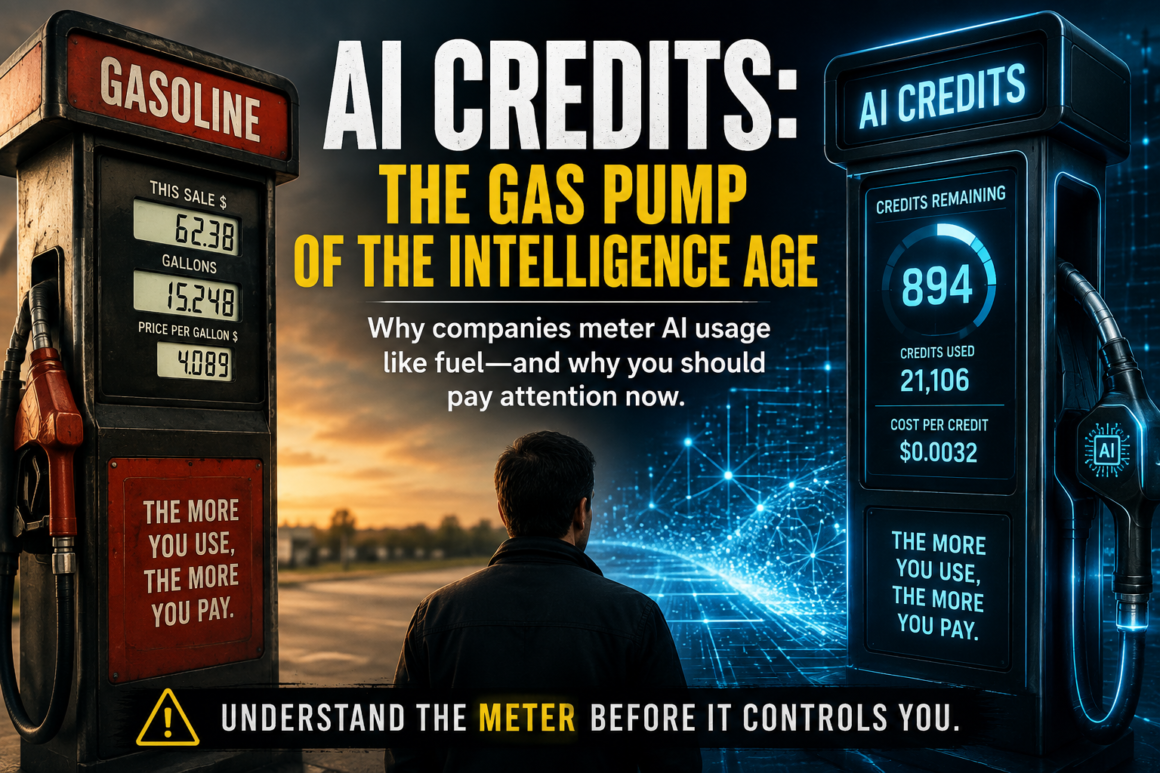
$18.72.
$31.46.
$47.91.
$62.38.
We need the fuel.
So we keep pumping.
Now imagine something unusual.
What if gasoline companies had sold gasoline subscriptions?
Pay $100 per month and drive all you want.
An interesting proposition—for the customer.
A terrible proposition for the gasoline company if that customer suddenly decided to drive 5,000 miles.
The meter is vastly more profitable.
The meter allows consumption and revenue to rise together.
And that is precisely what AI credits can accomplish.
The New Meter
The gas pump measures gallons.
The AI platform measures credits.
Different commodity.
Similar principle.
The more you consume, the more you pay.
And there is another similarity that should concern us.
The usefulness of AI is increasing extraordinarily quickly.
Today someone might use AI to write an email.
Tomorrow that same person may use it to manage a business.
Design products.
Write software.
Conduct legal research.
Analyze investments.
Produce advertising.
Create movies.
Engineer machinery.
Develop inventions.
Tutor their children.
Plan their life.
Operate autonomous systems.
Create entire companies.
AI is moving from novelty to utility.
From utility to productivity.
And from productivity toward dependency.
That progression creates an extraordinary economic opportunity for whoever controls the meter.
Dependency Is One of the Most Valuable Business Models Ever Invented
This does not require a conspiracy.
It requires only incentives.
Companies naturally search for ways to increase revenue.
Investors reward growth.
Executives study customer behavior.
Pricing departments calculate willingness to pay.
And few business opportunities are more attractive than a product whose customers increasingly believe:
“I cannot afford to run out.”
We already understand this psychology with gasoline.
We understand it with electricity.
We understand it with cellular data.
We understand it with cloud computing.
We understand it with storage.
AI may become more consequential than all of them.
Imagine a company halfway through developing a product with AI.
Its code was generated with AI.
Its documentation was generated with AI.
Its graphics were created with AI.
Its marketing was created with AI.
Its research was conducted with AI.
Its employees now depend upon AI.
Then the screen says:
You have 4% of your credits remaining.
What happens next?
They buy more.
The purchase is no longer discretionary in the ordinary sense.
The project has created its own dependency.
That is where the economics become fascinating.
And potentially dangerous.
Watch the Meter
Credits are often presented as harmless little digital units.
1,000 credits.
5,000 credits.
20,000 credits.
They do not feel quite like dollars.
That may itself be psychologically useful to the seller.
A customer may hesitate before approving another $17 purchase.
But clicking “Add 2,500 Credits” feels different.
Casinos discovered long ago that converting money into chips changes the psychological experience of spending.
Video games learned the same lesson with coins, gems, tokens, and virtual currencies.
AI companies did not invent metered consumption.
But artificial intelligence may become one of the most powerful applications of it the world has ever seen.
Because what is being metered is not entertainment.
It is increasingly human capability.
This Is Why Consumers Should Pay Attention Now
There is nothing inherently unethical about charging customers according to usage.
AI companies have real expenses.
Someone who generates three images per month should not necessarily subsidize a company generating three million.
Usage pricing can be perfectly reasonable.
But consumers should understand what kind of economic system they are entering.
There is an enormous difference between:
“I subscribe to this tool.”
and
“My productivity requires continuous purchases from this meter.”
That distinction will become increasingly important as AI becomes embedded in everyday life.
We should therefore ask more questions when evaluating AI products.
Is there a true unlimited subscription?
What happens when I exceed normal usage?
Do unused credits expire?
Can the company change the number of credits required for the same task?
Does generating something twice cost twice as much?
Will a project become economically difficult to move elsewhere once I have built it inside this ecosystem?
Most importantly:
Am I buying a tool—or am I gradually becoming dependent upon a meter?
The Intelligence Age Will Have Gas Pumps
Human beings are becoming accustomed extraordinarily quickly to having intelligence on demand.
Ask.
Create.
Analyze.
Design.
Build.
Revise.
Try again.
What would once have required a department of professionals can increasingly begin with one person typing instructions into a computer.
That is revolutionary.
It is also enormously habit-forming.
Once you have experienced that level of capability, losing access to it feels like losing something.
And industries understand the economics of things people do not want to lose.
So the next time an AI company offers you thousands of brightly packaged credits, do not look at them merely as credits.
Picture yourself standing beside a gasoline pump.
Watch the numbers turn.
Think about what happens when an entire civilization becomes dependent upon the product flowing through that meter.
And remember one very old business principle:
A subscription places a ceiling on what the seller can collect from a customer during a given period.
A meter does not.
AI may become one of the greatest tools humanity has ever created.
But as we enthusiastically enter the Intelligence Age, we should remain intelligent enough to notice something else being built alongside it.
The meter.