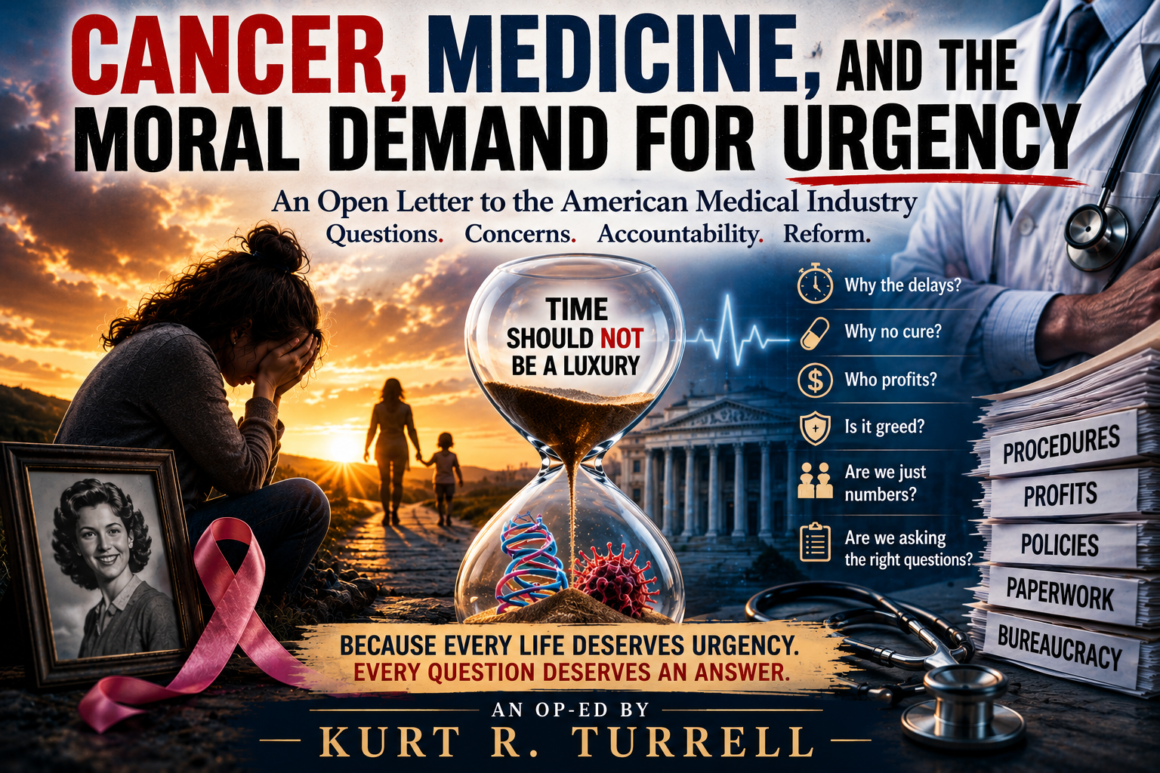
Cancer, Medicine, and the Moral Demand for Urgency
[An open letter to the Medical Industry by Kurt R. Turrell.]
I hate the word cancer.
For many people, cancer is a medical diagnosis. For me, it is also a wound in memory. My wonderful mother lost her battle with breast cancer in 1977 at the age of forty-two. I was only fifteen years old. Her death did not merely take my mother from me; it shattered the emotional structure of my young life. In ways I did not yet understand, grief became anger, anger became blame, and blame became a lifelong suspicion of the medical industry’s relationship with cancer.
In 1977, cancer felt like a death sentence. Medical science was not where it is today. Survival rates were lower. Treatments were harsher. The public knew far less about early detection, genetics, tumor staging, and targeted therapies. Since that time, cancer outcomes have improved significantly. In the mid-1970s, the overall five-year survival rate for all cancers combined in the United States was roughly half. Today, reports from major cancer organizations show that approximately seven in ten people diagnosed with cancer survive at least five years. Breast cancer survival has also improved dramatically, especially when detected early. For localized breast cancer, the five-year relative survival rate is now above 99 percent; for regional spread it is about 87 percent; but for distant metastatic breast cancer, it remains about 33 percent. Those numbers reveal both progress and tragedy. They prove that medicine has advanced, but they also prove that cancer remains terrifying.
A “cure for cancer” does not universally exist because cancer is not one disease. It is a category of many diseases involving abnormal cell growth, genetic mutations, tissue invasion, immune evasion, and, in many cases, metastatic spread. Breast cancer is not the same as pancreatic cancer. Uterine cancer is not the same as leukemia. Even within one type of cancer, there may be different subtypes that behave differently and respond to different treatments. This scientific complexity helps explain why a single universal cure has not appeared. But scientific complexity does not remove the moral obligation to ask hard questions.
In 2023, my closest friend was diagnosed with cancer of the uterus. Because I understood that many cancers can spread rapidly, I was deeply upset that she was not scheduled for surgery immediately. Instead, there were three more months of waiting. To a hospital system, three months may be a scheduling delay, a clinical pathway, or a matter of prioritization. To a patient and the people who love her, three months can feel like a lifetime. Every day feels like a gamble. Every week feels like an opportunity for the enemy to advance.
I took care of my friend for five months after major surgery that removed her uterus and reproductive organs. Her oncologist later said there were no signs of cancer and that she was cancer free. I was grateful. I was relieved. But I still wondered whether too much time had passed before treatment began. Now, in 2026, the same doctor has announced that her cancer is back. The recommendation is chemotherapy and radiation. Once again, that ugly word has returned: cancer.
It is difficult not to feel rage. It is difficult not to feel betrayed. It is difficult not to look at the American medical industry and ask whether the system is truly organized around saving lives as urgently as possible—or whether it is organized around procedures, billing codes, institutional convenience, insurance approvals, liability management, and profit.
The question of treatment delay is not merely emotional. It is also practical and ethical. Research has shown that delays in cancer treatment can increase mortality risk. In one major analysis, even a four-week delay in treatment was associated with a higher risk of death across several forms of cancer treatment, including surgery, systemic therapy, and radiotherapy. That does not mean every delay causes every recurrence. It does not mean every doctor is negligent. It does mean that delay matters. When cancer is diagnosed, time should be treated as a medical resource. The system should not casually spend what the patient may not have.
This raises a serious question: when a person is diagnosed with cancer, why is that person not placed into a fast-track treatment program immediately? Why is there not a national standard that treats cancer with the same urgency that emergency medicine applies to stroke, heart attack, or major trauma? Certainly, some cancers require additional imaging, biopsies, molecular testing, staging, or second opinions before treatment begins. Rushing blindly can be dangerous. But the opposite danger is also real: excessive delay, fragmented scheduling, insurance hurdles, specialist bottlenecks, and a system that sometimes moves at bureaucratic speed while the disease moves at biological speed.
The medical industry often speaks of “standard of care.” But the public has the right to ask whether the standard of care is always the highest moral standard. A standard may be legally defensible and still feel ethically inadequate. A doctor may follow a protocol and still fail to communicate urgency. A hospital may meet its internal benchmarks and still leave a family feeling abandoned. A patient may be told, “This is normal,” while the family quietly wonders whether “normal” is good enough.
Then there is the harder question: why is there not yet a cure?
The honest scientific answer is that cancer is extraordinarily complex. Yet the public’s suspicion does not arise from ignorance alone. It also arises from the economics of American medicine. Cancer treatment is a massive industry. Chemotherapy, radiation, immunotherapy, surgery, imaging, hospital stays, specialty drugs, insurance billing, and long-term follow-up care generate enormous amounts of money. Pharmaceutical companies profit from treatments. Hospitals profit from procedures. Insurers manage risk and payment. Medical associations shape professional standards. Government programs such as Medicare and Medicaid finance enormous portions of care. In such an environment, it is not irrational for ordinary people to ask whether financial incentives always align with curing disease as quickly, affordably, and completely as possible.
To question these incentives is not the same as proving a conspiracy. It is possible for a system to produce morally troubling outcomes without a secret meeting in a dark room. Greed does not always require conspiracy. Sometimes greed hides in policy, reimbursement structures, patent law, drug pricing, administrative delay, and institutional self-preservation. A system can be full of sincere doctors and nurses while still being distorted by money. A hospital can employ compassionate people and still operate within an industry that rewards treatment more predictably than prevention or cure.
This is why public trust is fragile. When patients feel rushed through appointments, when doctors seem unreachable, when treatment plans are explained in technical language, when families wait weeks for answers, when billing departments move faster than care teams, suspicion grows. People begin to ask whether patients are being treated as human beings or as medical accounts. They ask whether doctors become complacent. They ask whether specialists have good days and bad days. They ask whether errors are admitted openly or hidden behind professional language. They ask whether the white coat has become a shield against accountability.
Doctors are not gods. They are human beings with training, expertise, pressure, fatigue, assumptions, habits, and limitations. Many are deeply compassionate. Many entered medicine to heal. Many carry emotional burdens that patients never see. But respect for doctors does not require silence from patients. Expertise should be respected, but it should not be worshiped. Authority should be questioned, especially when life and death are at stake.
The Hippocratic Oath is often summarized by the phrase “First, do no harm.” Whether or not that exact phrase appears in every modern version, the spirit of medicine is supposed to be rooted in healing, humility, and the protection of human life. The question is whether modern American medicine still consistently reflects that spirit. Would Hippocrates recognize today’s system—a system of insurance networks, pre-authorizations, medical debt, pharmaceutical pricing, rushed appointments, defensive medicine, and profit-driven institutions—as a healing profession first? Or would he see a system in danger of becoming too large, too expensive, too bureaucratic, and too comfortable with suffering?
Cancer survival statistics show progress, but they should never become an excuse for complacency. If seven out of ten survive five years, then three out of ten do not. If localized endometrial cancer has a five-year relative survival rate around 96 percent, but distant endometrial cancer has a survival rate around 22 percent, then early action matters. If localized breast cancer survival is above 99 percent, but distant metastatic breast cancer survival is near one-third, then delay, detection, staging, and treatment access are not abstract issues. They are life-and-death matters.
Statistics can comfort, but they can also conceal. A survival rate does not describe the terror of waiting for surgery. It does not describe the pain of chemotherapy. It does not describe the family member sleeping in a chair beside the bed. It does not describe the financial ruin of treatment. It does not describe the patient who was told she was cancer free, only to hear years later that the disease has returned. Numbers are necessary, but they are not enough. Behind every statistic is a face, a family, a future, and a grief that cannot be measured.
The cancer industry needs more than better medicine. It needs moral reform. It needs urgency. It needs transparency. It needs patient advocates with real power. It needs outside oversight that is not captured by the same institutions it is supposed to evaluate. It needs honest communication about risks, recurrence, timing, alternatives, second opinions, clinical trials, and treatment delays. It needs doctors who welcome questions rather than resent them. It needs hospitals that measure success not only in procedures completed, but in lives preserved, suffering reduced, and trust earned.
Calls to Action
If the American medical industry wants to restore trust, then it must do more than defend itself. It must reform itself. Patients and families should not be expected to quietly accept delays, vague explanations, institutional arrogance, or systems that seem more concerned with process than urgency. Cancer demands more than sympathy. It demands action.
First, every confirmed cancer diagnosis should trigger a fast-track treatment pathway. Cancer patients should not be left wandering through disconnected referrals, delayed appointments, and administrative bottlenecks. Once cancer is confirmed, there should be a defined and urgent process for imaging, staging, specialist review, treatment planning, and the beginning of treatment. If treatment must be delayed for legitimate medical reasons, that delay should be explained clearly, documented, and reviewed.
Second, every cancer patient should have access to a trained patient advocate or navigator with real authority. A frightened patient should not have to become a medical project manager while fighting for his or her life. Patients need someone who can help coordinate appointments, obtain records, explain treatment steps, ask hard questions, and challenge unnecessary delays.
Third, hospitals and cancer centers should publicly report treatment-delay metrics. The public deserves to know how long each institution takes, on average, from diagnosis to first treatment. These numbers should be reported by cancer type and treatment type. If hospitals can advertise their excellence, they should also disclose their speed, bottlenecks, and delay patterns.
Fourth, cancer patients should have a protected right to rapid second opinions. No patient should feel intimidated, punished, or dismissed for asking another doctor to review a diagnosis or treatment plan. Second opinions should be normalized, expedited, and covered by insurance when cancer is involved.
Fifth, insurance companies should be prohibited from causing unreasonable delays in cancer care through excessive prior authorization, network restrictions, or administrative obstruction. Cancer does not wait politely for paperwork. If a treatment is medically necessary and time-sensitive, the approval process should move with urgency.
Sixth, serious treatment delays should be subject to independent review. The medical industry should not be the only judge of itself. Outside review boards, independent from hospital ownership, pharmaceutical influence, and insurance control, should evaluate serious cases where patients or families reasonably question whether delay, poor communication, or system failure contributed to harm.
Seventh, cancer patients should receive plain-language explanations of recurrence risk. When a doctor says “cancer free,” the patient deserves to understand what that means, what it does not mean, what risks remain, what warning signs matter, and what follow-up plan is necessary. Hope should never be given without clarity.
Eighth, the United States must invest more aggressively in prevention, early detection, recurrence research, and true cures. Treatment is necessary, but treatment should not become the most profitable substitute for cure. The goal should not be to maintain a permanent cancer economy. The goal should be to end as much cancer suffering as science can possibly end.
Ninth, doctors and cancer centers should recommit to humility. Technical expertise is not enough. Patients need physicians who explain, listen, admit uncertainty, welcome questions, and remember that the person in the exam room is not a case file. The patient is a human life.
Tenth, the public must stop being passive. Patients and families have the right to ask: Why are we waiting? What is the risk of waiting? Can treatment begin sooner? Is there another option? Should we seek a second opinion? What happens if we delay? These questions are not disrespectful. They are necessary.
The public must also change. We cannot surrender our voices because the system is complicated. We cannot assume that institutions are always honest simply because they are prestigious. We cannot assume that a doctor is infallible because he or she is highly trained. We cannot be passive when the stakes are life itself. Patients and families must ask questions. They must request records. They must seek second opinions. They must ask why treatment is being delayed, what the risks of delay are, whether earlier intervention is possible, and whether another institution can move faster. None of this is disrespectful. It is responsible.
Cancer is an ugly word. It has taken mothers, fathers, spouses, friends, children, futures, and peace of mind. It took my mother when she was only forty-two. It damaged my youth. It returned to threaten someone I love decades later. So yes, I question the system. I question the pace. I question the money. I question the complacency. I question whether the American medical industry has become, in some ways, a cancer within itself—growing too large, consuming too much, defending itself too fiercely, and forgetting that humanity should be at the center of all medicine.
But questioning is not hopelessness. Questioning is a form of moral resistance. It is a refusal to let grief become silence. It is a refusal to let institutions become untouchable. It is a refusal to accept that “this is just how things are.”
If cancer treatment has improved since 1977, then it can improve further. If survival rates have risen, then they can rise again. If treatments are better now than they were when my mother died, then the next generation deserves treatments better than what we accept today. The goal should not be merely to manage cancer more profitably. The goal should be to prevent it where possible, detect it early, treat it urgently, cure it wherever science allows, and never forget that the patient is not a case number.
The heart of medicine must be human life. Anything less deserves to be questioned.