Musk Could Probably Give All 8.3 Billion People on Earth a $100 Bill
There are financial headlines, and then there are financial headlines that make you stop, blink twice, and wonder if someone accidentally added three extra zeroes.
The recent SpaceX IPO belongs in that second category.
If current estimates are even close to accurate, Elon Musk may now be worth somewhere around the one-trillion-dollar neighborhood. That is not “rich.” That is not “very rich.” That is not even “billionaire rich.”
That is a different financial species.
To understand how large that number is, forget Wall Street language for a moment. Forget market capitalization, Class A shares, Class B voting power, restricted stock, options, and all the language that makes normal people suddenly remember they have laundry to fold.
Let’s ask a simple question:
If Elon Musk could somehow liquidate everything and divide the money equally among every human being on Earth, how much would each person get?
The population of Earth is roughly 8.3 billion people.
Now take a rough Musk net worth estimate of about $1.0 trillion to $1.1 trillion.
Do the simple math:
$1 trillion divided by 8.3 billion people equals about $120 per person.
At $1.1 trillion, the figure rises to about $133 per person.
So yes, in headline language, it is reasonable to say:
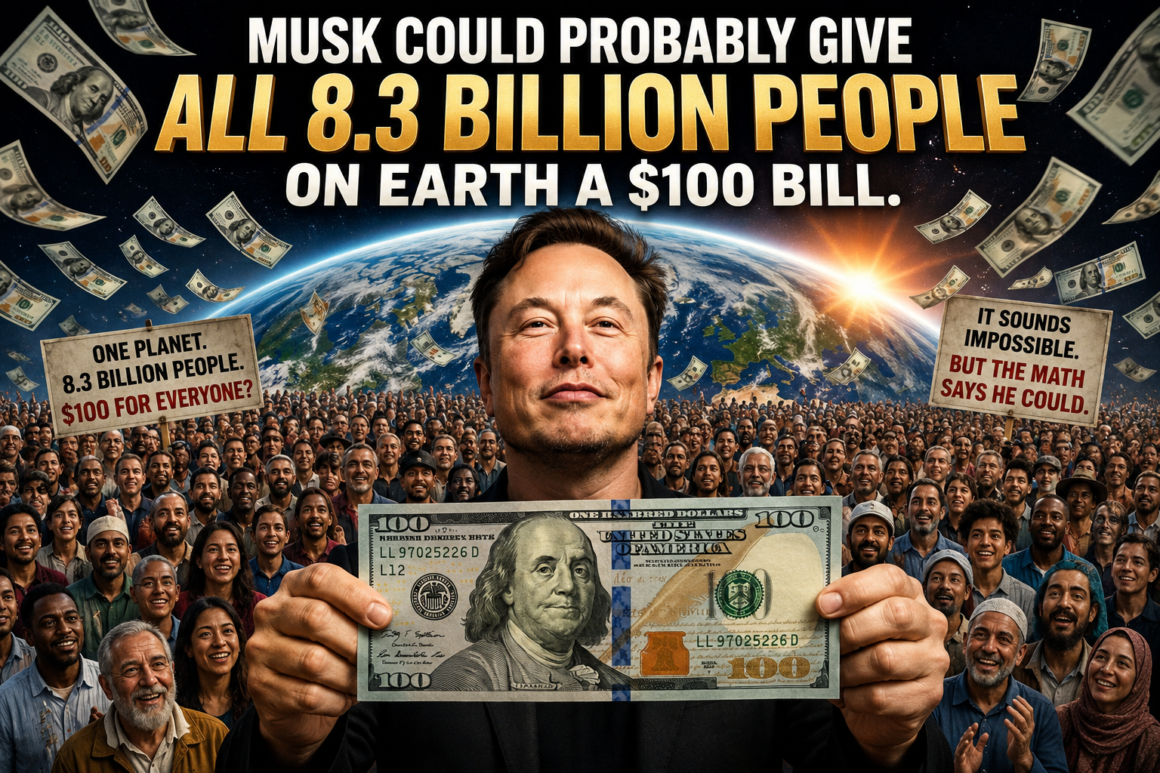
Elon Musk could probably give all 8.3 billion people on Earth a $100 bill.
And after doing that, at least on paper, he might still have money left over.
That sentence sounds ridiculous. But the math is not ridiculous.
It is just the scale that feels impossible.
How Did We Get Here?
The chronological logic is fairly simple.
First, SpaceX had a historic IPO. The company’s public valuation reportedly reached breathtaking levels, making it one of the biggest financial events in modern market history.
Second, Elon Musk owns a massive stake in SpaceX. That means when SpaceX rises in value, Musk’s personal net worth rises dramatically with it.
Third, Musk also owns major wealth tied to Tesla and other ventures. Tesla stock alone has long been one of the biggest drivers of his wealth. If Tesla rises while SpaceX is also rising, Musk’s net worth does not just increase. It launches.
That word is appropriate here.
Fourth, the next wealthiest people in the world are not especially close to him. They are still unimaginably wealthy, of course. But the gap between Musk and everyone else may now be so large that he appears almost uncatchable for the foreseeable future, assuming no major collapse in SpaceX, Tesla, or his other holdings.
The $100 Thought Experiment
Let’s keep the thought experiment simple.
There are about 8.3 billion people on Earth.
If Musk is worth about $1 trillion, dividing that by 8.3 billion gives every person about $120.
That means every baby, every student, every farmer, every teacher, every retiree, every billionaire, every prisoner, every president, every king, every monk, every influencer, every cab driver, every grandmother, every toddler, and every person standing in line somewhere wondering why the line is not moving could theoretically receive a $100 bill.
One crisp Benjamin Franklin for everyone.
Naturally, this would be the strangest global payday in human history.
Imagine the logistics.
A child in Texas gets $100.
A fisherman in the Philippines gets $100.
A grandmother in Nigeria gets $100.
A schoolteacher in Brazil gets $100.
A monk in Nepal gets $100.
A banker in London gets $100.
A goat herder in Mongolia gets $100.
A billionaire in Dubai also gets $100, which seems unnecessary, but equal means equal.
The headline is shocking because the image is so easy to understand. A trillion dollars is too large for the human mind to hold comfortably. But a $100 bill is very easy to understand.
That is what makes the comparison powerful.
But Could He Really Do It?
Not exactly.
This is where the fun must shake hands with reality.
Most of Musk’s wealth is not sitting in a checking account. It is not a giant Scrooge McDuck vault filled with gold coins, rocket parts, and Tesla chargers.
His wealth is mostly tied up in stock and ownership stakes.
If he tried to sell everything all at once, the value of those holdings would probably fall sharply. Markets do not calmly absorb the sudden liquidation of hundreds of billions—or a trillion dollars—of founder stock without reacting.
There would also be taxes, selling restrictions, transaction limits, legal complications, investor panic, and probably several very nervous people wearing expensive suits in conference rooms.
So the “everyone gets $100” claim is not a practical prediction.
It is a scale illustration.
On paper, based on current estimates, Musk’s wealth appears large enough to divide into a $100 payment for every person on Earth.
In the real world, a full liquidation would likely produce less. Maybe much less. A more realistic liquidation-adjusted estimate might fall below the clean headline number.
But the fact that the headline is even mathematically plausible is astonishing.
The Bigger Point
This is not really an article about whether Elon Musk should give everyone $100.
It is an article about scale.
We now live in an era where one individual’s paper wealth can be compared not just to companies, not just to nations, but to the entire human population.
That is historically extraordinary.
Whether one admires Musk, criticizes him, worries about him, studies him, invests in him, or simply watches him like a financial meteor streaking across the sky, the conclusion is hard to avoid:
Elon Musk is no longer merely the richest person in the world.
He may be the first person whose wealth can be meaningfully described in planetary terms.
And that is why the sentence lands with such force:
Elon Musk could probably give all 8.3 billion people on Earth a $100 bill.
Not because he will.
Not because he should.
But because, astonishingly, the math says he probably could.
Disclaimer
The figures discussed in this article are based on current public estimates, reported market valuations, population estimates, and rough mathematical assumptions. These numbers fluctuate intensely and can change rapidly due to stock prices, private-company valuations, taxes, ownership structures, market liquidity, legal restrictions, and other financial realities. This article is a simplified thought experiment designed to illustrate scale, not a precise accounting statement, investment analysis, or claim that Elon Musk has one trillion dollars in cash available for distribution.