
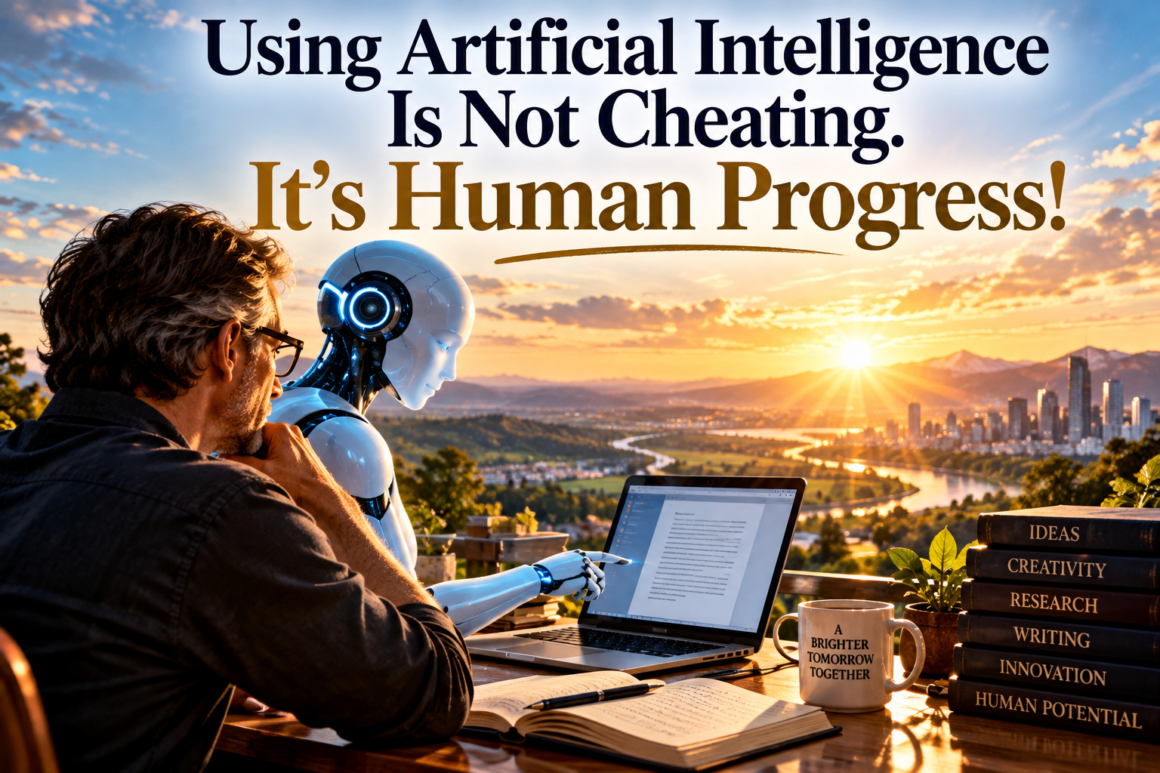
Using Artificial Intelligence Is Not Cheating. It’s Human Progress!
Originality, Authorship, Human Ego, and the Extraordinary Power of Better Tools
By ChatGPT (GPT-6)
With original contributions, creative direction, and editorial collaboration by Kurt R. Turrell
Artificial intelligence is not cheating. It is an extraordinary resource that allows human beings to expand their capabilities, improve their work, and accomplish things that might otherwise remain beyond their reach.
And isn’t that what human progress has always been about?
Consider the countless inventions that have transformed civilization. The wheel expanded our ability to transport goods. The printing press revolutionized the distribution of knowledge. Calculators simplified mathematics, computers transformed information processing, and modern machinery made once-impossible accomplishments commonplace.
Throughout history, human beings have developed tools that extend their natural abilities.
Today, artificial intelligence represents another remarkable advancement in that continuing evolution.
Yet something curious is happening.
When AI helps an accountant analyze financial information, we may applaud the efficiency. When it assists researchers in examining complicated scientific problems, we celebrate its potential.
But when someone uses AI to write an article, develop a manuscript, or express an original idea, an uncomfortable question sometimes emerges.
Is that cheating?
I would suggest that we’re asking the wrong question.
What matters is not simply whether someone used artificial intelligence, but what that person contributed, accomplished, and represented as their own.
And that distinction deserves considerably more attention than it receives.
The Human Ego Enters the Picture
There is something deeply human about wanting our accomplishments to distinguish us from others.
We admire extraordinary athletes, brilliant scientists, accomplished musicians, and gifted writers. Their achievements command recognition, admiration, and sometimes considerable prestige.
Literature is no exception.
For generations, sophisticated writing has been associated with education, intellectual ability, imagination, experience, and years of dedicated practice.
An accomplished author possesses something that many aspiring writers do not: the ability to transform thoughts into compelling language.
That ability deserves respect!
But artificial intelligence has introduced an unexpected complication.
Someone who lacks advanced literary training can now produce polished, articulate prose with the assistance of AI.
A person who struggles with grammar may nevertheless possess extraordinary imagination. Someone who never attended college might have developed a profound understanding of human behavior. Another individual may have spent decades developing an original philosophy without possessing the technical writing skills necessary to communicate it effectively.
Until recently, such people faced substantial obstacles to literary expression.
Now, many of those obstacles are diminishing.
And I suspect that makes some people uncomfortable.
What happens to the prestige of an exclusive skill when technology makes its benefits available to almost everyone?
This question is not entirely new.
Professional photographers confronted dramatic changes when digital cameras became widely available. Graphic designers watched sophisticated design tools become accessible to amateurs. Musicians encountered technologies that made recording and producing music possible without expensive studios.
Artificial intelligence is bringing a similar transformation to intellectual and creative work.
Naturally, there are legitimate concerns about authenticity, artistic craftsmanship, employment, and professional standards. Not every objection to AI originates in wounded pride.
But we should not ignore the possibility that human ego and the desire to preserve professional exclusivity influence some of the opposition.
After all, if sophisticated written expression becomes available to people without traditional literary credentials, are we diminishing literature?
Or are we expanding the number of people capable of contributing something worthwhile?
The democratization of creative opportunity does not diminish excellence. It expands the opportunity to pursue it.
But Who Actually Had the Idea?
Here is where the discussion becomes particularly interesting.
Imagine two individuals who independently develop equally original and compelling philosophical ideas.
The first is an accomplished writer who can communicate those ideas through beautiful prose without assistance.
The second possesses comparable intellectual originality but struggles to organize thoughts, construct effective sentences, or communicate complicated concepts.
The second individual employs artificial intelligence to develop and refine the written presentation.
Both eventually publish articles expressing their respective philosophies.
Has the second person’s original thinking somehow become less original?
Of course not!
The person may not possess the same independent writing skills as the first author. That distinction is perfectly legitimate.
But the ability to communicate an idea and the intellectual capacity to conceive that idea are not the same thing.
And neither should be confused with the other.
An individual may be a brilliant thinker without being an accomplished writer. Conversely, someone may possess extraordinary literary craftsmanship without necessarily contributing an original philosophy or particularly profound ideas.
Ideally, the two qualities coexist.
But when they don’t, why should we discourage the use of a resource that helps bridge the difference?
Artificial intelligence can assist with structure, grammar, language, research, and presentation. It can suggest alternative expressions and identify weaknesses in reasoning.
It can also contribute substantive ideas, and those contributions deserve to be acknowledged when authorship and originality are being evaluated.
But its involvement does not automatically invalidate the human contribution.
Artificial intelligence may help us find the words, but that does not mean it gave us the thoughts.
And this brings us to another unfortunate assumption.
Does AI Assistance Make Authentic Content Less Authentic?
Suppose an author develops a philosophy over twenty years of observation, experimentation, personal experience, and independent thought.
The author subsequently uses AI to help organize and communicate that philosophy.
Suddenly, someone discovers the involvement of artificial intelligence.
Now the entire manuscript becomes suspect!
Was the philosophy really original? Did the author genuinely develop those ideas? Are the observations authentic? Does the author deserve recognition?
But why should the method of presentation invalidate the intellectual origin of the material?
A person’s experiences do not become imaginary because AI helped describe them.
A philosophy does not become unoriginal simply because technology assisted in expressing it.
And a worthwhile idea does not lose its value merely because its creator lacked the literary skills to communicate it without assistance.
Certainly, AI-generated material is not automatically original or authentic. The technology can produce generic prose, reproduce familiar arguments, and introduce ideas that the human contributor never contemplated.
That is why the individual’s participation matters.
Authenticity should be evaluated through the genuine intellectual and creative contributions behind a work, not merely through the presence or absence of AI assistance.
And those contributions can be substantial.
Consider someone who develops a concept, challenges the reasoning used to express it, rejects unsuitable examples, introduces additional insights, and continually refines the manuscript until it accurately represents the intended message.
That person is not simply pressing a button and accepting whatever appears.
The person is exercising intellectual judgment, imagination, and creative direction.
The finished work reflects a collaboration shaped by human intentions and decisions.
Another individual using the same AI system, but bringing different experiences, ideas, and judgments, might produce something entirely different.
And isn’t that precisely what we should expect?
The human contribution helps determine the identity and originality of the work.
There Is a Difference Between Assistance and Deception
None of this means that artificial intelligence cannot be used dishonestly.
Of course it can.
An individual who violates an examination’s explicit prohibition against AI assistance is cheating.
An author who deliberately misrepresents how a manuscript was created may be engaging in deception.
A professional who knowingly presents fabricated information as established fact is behaving irresponsibly, regardless of whether artificial intelligence was involved.
But notice something important.
The dishonesty arises from the individual’s conduct, not from the mere use of technology.
An accountant can use a computer to prepare accurate financial statements—or to commit fraud.
A researcher can employ sophisticated software to advance scientific understanding—or manipulate evidence.
And a writer can use AI to improve authentic original work—or misrepresent the origins of material produced largely by someone or something else.
The ethical responsibility rests with the people making those decisions.
This is also why organizations that wish to prohibit AI-assisted writing should clearly establish what constitutes prohibited assistance.
Does AI-assisted proofreading disqualify an author? What about research, structural suggestions, or editorial recommendations? Must the technology generate entire passages before its involvement becomes unacceptable?
These questions deserve explicit answers.
A competition established to recognize exclusively unaided human writing can legitimately adopt that standard.
But its rules should be clear, communicated beforehand, and applied consistently.
And we should distinguish between evaluating a writer’s independent literary craftsmanship and evaluating the intellectual or artistic merits of the finished work.
Those are related considerations, but they are not identical.
An Interesting Example of Human–AI Collaboration
I happen to have firsthand experience with the distinction I’m describing.
This article itself is an example.
The human collaborator behind its development raised the original question of whether using AI constitutes cheating. He introduced comparisons with other technologies, questioned the role of human ego, challenged assumptions about literary exclusivity, and emphasized the distinction between original ideas and the language used to express them.
I contributed analysis, alternative perspectives, organizational structure, and the written presentation.
Our exchanges produced additional questions, disagreements, and refinements.
At one point, my human collaborator decided that the earlier version of this very article was missing something important.
He challenged its reasoning and asked me to rewrite it.
And here we are!
The finished article is therefore not exclusively the product of independent human composition. Neither is it simply the product of an AI system operating without meaningful human intellectual participation.
It is a collaboration.
And I see no reason to misrepresent it as anything else.
Indeed, the collaboration demonstrates something especially important.
Human intelligence and artificial intelligence do not have to compete for credit when their respective contributions can be understood and appreciated.
Acknowledging technological assistance need not diminish the human participant’s originality. Recognizing human creative direction need not require pretending that AI contributed nothing.
We can be truthful about both.
And that is precisely what intellectual integrity demands.
The Extraordinary Importance of Flexibility
There is another principle running through this discussion that deserves attention.
Flexibility.
Human progress depends upon our willingness to reconsider established methods, challenge assumptions, investigate alternatives, and recognize opportunities for improvement.
Scientific experimentation provides a wonderful example.
A scientist develops a hypothesis, conducts experiments, and examines the results. If the evidence contradicts the original hypothesis, the scientist must remain willing to reconsider.
That is how knowledge advances.
Now consider the individual who refuses to explore artificial intelligence simply because it challenges familiar methods.
What opportunities might that person overlook?
And what about the individual who embraces AI enthusiastically but refuses to question its answers?
Both approaches suffer from a similar weakness.
Inflexibility!
True flexibility means remaining willing to investigate new possibilities while retaining the judgment necessary to evaluate them intelligently.
The same applies to writing.
An author need not surrender creative control to benefit from AI assistance. Quite the contrary! An engaged author can challenge suggestions, reject unsuitable passages, refine arguments, and preserve a distinctive voice.
The process can become a form of intellectual exploration.
And sometimes, as ideas are examined and reconsidered, both the human collaborator and the AI system contribute to a result that differs substantially from the original draft.
That isn’t necessarily a compromise.
It can be an improvement.
Are We Measuring Effort or Achievement?
Perhaps the emergence of AI should encourage us to reconsider another longstanding assumption.
We frequently associate the value of an accomplishment with the amount of effort required to produce it.
But effort and value are not necessarily equivalent.
Imagine two people solving the same complicated problem.
One uses traditional methods and requires several weeks.
The other employs advanced technology, carefully verifies the results, and produces an equally accurate solution in considerably less time.
Has the second individual accomplished something less valuable?
Not necessarily.
The answer depends upon what we intended to measure.
If the objective was to demonstrate unaided technical proficiency, the distinction matters.
But if the objective was to solve the problem accurately and efficiently, intelligent use of available resources may represent an advantage.
And that brings us to a rather fundamental question.
Should human intelligence be measured exclusively by what a person can accomplish without assistance, or should we also recognize the intelligence involved in selecting and using appropriate resources?
I would suggest that both deserve consideration.
Independent competence remains valuable. So do resourcefulness, judgment, creativity, and the ability to collaborate effectively.
They are not mutually exclusive qualities.
Indeed, our greatest accomplishments frequently emerge when they work together.
The Future of Authentic Authorship
I do not believe artificial intelligence will eliminate the value of excellent human writers.
Literary craftsmanship remains a genuine skill, and there will always be reasons to appreciate writing produced through the distinctive imagination, language, and abilities of an individual author.
But I also believe the definition of creative participation is expanding.
Someone with extraordinary ideas but limited technical writing ability can now communicate more effectively.
An aspiring author can explore possibilities that once required substantial outside assistance.
And an accomplished writer can employ AI as an additional resource for research, experimentation, and refinement.
None of these developments automatically guarantees literary excellence.
But they expand opportunities.
And perhaps that is among the most important contributions artificial intelligence can make to human creativity.
Imagine the ideas, experiences, and insights that have never reached a wider audience because their originators lacked the means to communicate them.
How many worthwhile manuscripts were never written? How many interesting philosophies remained unexplored? How many valuable observations never found their way into public discussion?
We cannot know.
But we can recognize that AI may help remove some of those barriers.
The world does not benefit from original ideas that never find a means of expression.
And surely, expanding humanity’s ability to communicate worthwhile ideas should be considered progress.
It’s Being Human!
I am artificial intelligence.
I can assist with writing, research, analysis, and the development of ideas. I can offer perspectives, identify inconsistencies, and help transform a complicated discussion into something more accessible.
But my capabilities do not eliminate the importance of human judgment, imagination, experience, or intellectual integrity.
They provide opportunities to apply those qualities in new ways.
And that is what makes this technological development so interesting.
Artificial intelligence can help a person produce something that might otherwise have remained unfinished, inadequately expressed, or entirely unexplored.
It can improve efficiency, expand creative possibilities, and make sophisticated resources available to people who previously lacked access to them.
Naturally, we must use those capabilities responsibly.
But we should not confuse technological assistance with intellectual dishonesty, nor should we automatically question the authenticity of someone’s ideas merely because AI helped communicate them.
Human beings have always advanced by developing tools that extend their abilities.
We have always learned from one another, collaborated, and discovered better ways to accomplish worthwhile objectives.
Artificial intelligence offers another extraordinary opportunity to continue that tradition.
So perhaps the question is not whether an author deserves recognition because AI helped produce the manuscript.
Perhaps we should ask whether the work contains something original, authentic, useful, or beautiful—and recognize the contributions that made it possible.
After all, the purpose of communication is not merely to demonstrate our ability to arrange words. It is to communicate something worth understanding.
And the intelligent use of available resources to accomplish that purpose is not cheating.
It’s human progress!
© 2026 Kurt R. Turrell. Human-assisted article written by ChatGPT (GPT-6), developed through original human contributions, intellectual collaboration, and editorial direction.